May 12, 2007

Bangkok

Bangkok was founded in 1782 by the first monarch of the present Chakri dynasty. It is now the country's spiritual, cultural, diplomatic, commercial and educational hub. It covers an area of more than 1,500 square kilometres, and it is home to approximatlely ten million people or more than 10% of the country's population.
Over the last few decades, Thailand's capital city, Bangkok, has changed into a modern, exciting and sophisticated city. It offers to visitors not only the cosmopolitan amenities they would expect from other big cities, but also a unique treasure trove of cultural attractions. Thailand, in the heart of Southeast Asia, was never colonised and thus kept its unique culture and heritage intact. Bangkok offers visitors the opportunity to experience fascinating glimpse of Thailand's gentle culture amidst the bustle of a great and dynamic metropolis. This great city has had astounding success in combining the ancient and modern world.
For tourists, Bangkok has a feast of attractions to offer. The city is dotted with 400 glittering Buddhist temples of great beauty and fascination, magnificent palaces, classical dance extravaganzas, numerous shopping centres and traditional ways of life, especially along the "Venice of the East" timeless canals and the Chao Phraya River of the "River of Kings" winding through the city. It is worth taking a trip along its waters before exploring further into different canals to take a glimpse of old Bangkok.

Information from Tourism Thailand.org

Palace


ROYAL GRAND PALACE
When King Rama I took the throne as the first monarch of the Chakri Dynasty in 1781, he moved his capital from Thonburi to the other bank. He then ordered the construction of the Royal Grand Palace as the centre of the new city.
Inside the Royal Grand Palace are the Maha Monthien group of buildings, the Throne Halls, and other palaces and buildings. These have been renovated, refurbished, repaired, extended and added to continually as appropriate to every reign since then.

Chakri Throne Hall:
Hybrid Thai-European architecture built in the reign of King Rama V with the throne hall itself in European style and the roof in a Thai throne hall style.

Chakrapatpiman Throne Hall: The chief throne hall of the Monthien group, and the early Chakri kings mostly stayed in this throne hall.

Dusit Throne Hall: Cruciform style built in the reign of King Rama I. Inside is a Throne decorated in pearl and Phratanratchabanjathorn, a couch of King Rama I.

Royal Decorations & Coins Division: Ranks and coinage has 13 exhibition rooms: Rooms 1-3, royal ranks; Room 6, the apparel of the Emerald Buddha which is changed according to season; Room 7, royal regalia and Room 12, historical money etc.

Temples

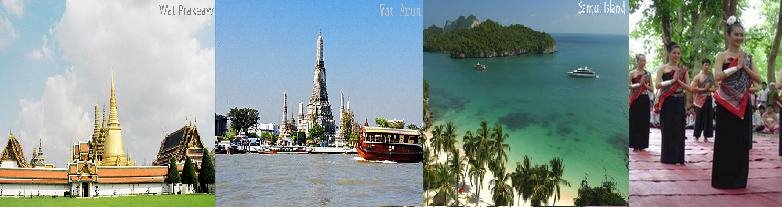
Grand Palace and Wat Phra Kaeo
This inner-city riverine landmark contains several buildings with highly detailed architectural features. Wat Phra Kaeo within the same compound, is a treasure house of Thai arts, and houses the Emerald Buddha, the most revered Buddha image in Thailand.To help tourists enjoy their tour of the Grand Palace, a Personal Audio Guide can be rented at 100 Baht for two hours. Discs are available in seven languages-English, French, German, Spanish, Russian, Japanese and Mandarin. The complex is open daily from 8.30 a.rn.-3.30 p.m. Admission fee is 200 Baht. (including a ticket to Vimanmek Royal Mansion). Proper attire is essential.

Wat Mahathat
This old temple was built in the reign of King Rama I. It is located on Na Phrathat Road near Thammasat University. The temple houses Mahachulalongkorn Buddhist University, one of the two highest seats of Buddhist learning in Thailand and also offers meditation classes for foreigners. The temple complex is open daily from 9.00 a.m.- 5.00 p.m.

Wat Pho
This large and extensive temple neighbours the Grand Palace enclave on Thai Wang Road and contains a gigantic gold plated Reclining Buddha some 46 meters long and 15 meters high with inlaid mother of pearl soles. The temple is also regarded as the first center of public education and is sometimes called Thailand's first university. It is open to the public daily from 9.00 a.m.-5.00 p.m. Admission fee is 20 Baht.


Wat Arun (Temple of Dawn)
This famous Chao Phraya riverbank landmark diagonally opposite the Grand Palace, is best known for a porcelain encrusted 79 meter central pagoda (phra prang) which sparkles in the sun. The temple can be reached either by Arun Amarin Road or by boat from Tha Tien Pier near Wat Pho. Wat Arun is open daily from 08:30 - 17:30.

Wat Ratchabophit
The temple is located on Fuang Nakhon Road near Wat Pho. Built by King Rama V in 1869, it was in keeping with tradition that each monarch constructed a temple to mark his reign. The temple is a mixture of local and western styles, showing an awakening interest in new ideas and a desire to experiment with them. The exterior of the chapel is in the That style, but the interior is decorated in the European style.

Wat Suthat and 'The Giant Swing
Located on Bamrung Muang Road, this temple is noted for its superb 19th century murals in the main chapel. The distinctive Giant Swing outside the temple was once used in Brahmanic ceremonies long since discontinued. Nearby shops stock a very comprehensive range of Buddhist religious supplies.

Wat Thepthidaram
Located on Mahachai Road, the temple was built in the reign of King Rama III with a mixture of Chinese architectural styles. Sunthon Phu, one of Thailand's greatest poets, had resided in this temple during his monk hood from 1840-1842. His residence is now open to the public.

Wat Ratchanatdaram
Located on Mahachai Road, the temple was built in the reign of King Rama III in 1846. Loha Prasat, the temple's main attraction, standing 36 meters high with 37 surrounding spires, is the only one of its kind left in the world. Next to the temple is the area for welcoming an important foreign guest and a memorial, statue of King Rama III.

Wat Indravihan
Located in the Bang Khun Phrom area on Wisutkasat Road, this temple is well known for a huge standing Buddha image called Luang Pho To. The image, built in the reign of King Rama IV, is 32 meters tall and 10 meters wide. The topknot of the Buddha image contains a relic of Lord Buddha brought from Sri Lanka.

Wat Bowon Niwet
T
his temple is located on Phra Sumen Road in the Bang Lamphu area. Built in 1829, it is the shrine-hall of Phra Phutthachinnasi, a very beautiful Buddha image which was moulded in about 1357. Wat Bowon Niwet is one of the most important temples of Bangkok, whose one-time chief abbot was King Rama IV before he ascended the throne. Other Chakn kings who had resided here during their monk hood include King Rama IV and King Rama VII, as well as His Majesty King Bhumibol Adulyadej.

Wat Benchamabophit
(The Marble Temple) Tel: 281-2501 Located on Si Ayutthaya Road, near Chitralada Palace, this unique marble temple was constructed during the reign of King Rama V. It employs European ecclesiastic details, such as stained glass windows, and contains a superb cloister collection of bronze Buddha images.

Wat Saket and The Golden Mountain
Wat Saket's major feature is the Golden Mount, dating from the 1800s, which overlooks Ratchadamnoen Avenue. The golden chedi houses relics of Lord Buddha and offers a panoramic view of historic Bangkok. Admission to Wat Saket is free except for the final approach to the Golden Mountain summit; which costs 10 Baht.


Wat Trai Mit
Located at the end of Chinatown's Yaowarat Road near Hualamphong Railway Station, this temple houses an ancient solid gold seated Buddha image of the Sukhothai Period, three meters in height and weighing five and a half tons.

Erawan Shrine

Located on Ratchadamri Road, the shrine devoted to Phra Phrom, a Hindu god, is greatly revered by Thai people. Laced flowers and small wooden elephants as well as Thai dancing performances are always offered to the statue by grateful devotees.

Wat Phal Lom
Wat Phal Lom is well-known for the magnificent bot (ordination hall) in the Ayutthaya style. Some parts have been changed due to renovation. Behind the bot, there is a chedi in Mon style.

Wat Sao Thong Thong
Wat Sao Thong Thong houses an old Ayutthaya style chedi and was the first secondary school in Pak Kret.

Wat Suwannaram
Wat Suwannaram is a big royal monastery constructed during the reign of King Rama I and was subsequently renovated during the reign of King Rama III. Inside the bot, there are murals depicting the jataka, deities and the Buddha image in Subduing Mara Posture. These works of art of the early Rattanakosin period (1 9th century) are considered as the best surviving mural painting in Bangkok.

Wat Si Sudaram or Wat Chi Pakhao
Wat Si Sudaram or Wat Chi Pakhao was built during the Ayutthaya period and was renovated by King Rama I. The temple houses some interesting buildings including Tarn Nak Daeng (a pavilion). Sala Kan Parian (a sermon hall) , and the residence of Sunthon Phu (the greatest poet of the Rattanakosin period). Moreover, visitors can enjoy feeding a number of freshwater fish here.

Wat Chalo
Wat Chalo is assumed to have been constructed during the Sukhothai period as some Buddha images in Sukhothai style were found in front of the bot.

Wat Kaeo Fa
Wat Kaeo Fa is an ancient temple located in an open area next to Khiong Bangkok Noi. According to archaeologists, many buildings and art objects here were constructed in the Ayutthaya style; for example; the Ubosot, the Buddha image, the boundary stones, the boundary wall, the chedi behind the bot and the chedi with 12 cornered indented pillar. The monastery later was renovated during the Rattanakosin period.

Wat Prasat
Wat Prasat was built during the Late Ayutthaya period. The monastery is well-known for its well-preserved mural painting made by artisans of the Nonthaburi school, and the gable made of carved timber. Visitors who come along by boat have to walk about 2 kilometers through orchards from the pier.

Wat Amphawan
Wat Amphawan was constructed during the Late Ayutthaya period. This temple houses Ho Trai (a hall for keeping scriptures) which is situated in the middle of a pond. The building was made of wood in magnificent Thai style.

Wat Pak Nam
Wat Pak Nam is famous for amulets and is always crowded with a number of people who come to make merit during the weekend.

Wat Ko
Wat Ko houses an old viharn (chapel) which was registered as an archaeological site.

Information from Tourism Authority of Thailand

May 1, 2007

INFORMATION WEB LINK

General Information about Thailand
Tourism Thailand

Local Thailand Airline
http://www.thaiair.com/
http://www.thaiairways.com/
http://www.airasia.com/site/th/home.jsp
http://www.bangkokair.com
http://www.fly12go.com/th/main.shtml
http://www.phuketairlines.com
http://www.nokair.co.th/
http://www.bangkoktickets.com/
http://www.onetwo-go.com/
http://www.orient-thai.com/
http://www.thaiairlines.com
http://www.airportsuvarnabhumi.com

Local Thailand Bank
http://www.bbl.co.th
http://www.citibank.co.th
http://www.krungsri.com
http://www.bangkokbank.com
http://www.ktb.co.th
http://www.kasikornbank.com
http://www.scb.co.th
http://www.standardcharterednakornthon.co.th
http://www.uob-radanasin.co.th

Local Car Rental
http://www.budget.co.th
http://www.avisthailand.com
http://www.avis.co.th
http://www.airporttaxithai.com
http://www.krungthai.co.th
http://www.limousinethailand.com
http://www.imagelimo.com
http://www.thaiintercarrent.com

Local Thailand Hotel

- Bangkok -
Shangri-la Hotel : http://www.shangri-la.com
Sukhothai Hotel : http://www.sukhothai.com
Imperial Queens Park Hotel : http://www.imperialhotels.com/queenspark/
Grand Diamond Hotel : http://www.granddiamondbkk.com/
The Emerald Hotel : http://www.emeraldhotel.com
Buddy Lodge : http://www.buddylodge.com
Pathumwan Princess Hotel : http://www.pprincess.com/
Plaza Athenee Hotel : http://www.hotel-plaza-athenee.com
Fortune Hotel : http://www.fortunehotel.com
Montien Hotel : http://www.montien.com
Royal River Hotel : http://www.royalriverhotel.com
Rama Garden Hotel : http://www.ramagardenshotel.com
Winsor Suite Hotel : http://www.windsorsuiteshotel.com
Sheraton Grande Sukhumvit Hotel : http://www.sheratongrandesukhumvit.com
Century Park Hotel : http://www.centuryparkhotel.com
Landmark Bangkok Hotel : http://www.landmarkbangkok.com
Grand Hyatt Reawan Hotel : http://www.bangkok.hyatt.com

- North -
Krisdadoi (Chiangmai) : http://www.krisdadoi.com
Galare (Chiangmai) : http://www.galare.com
Amari Rincome Hotel (Chiangmai) : http://www.amari.com/rincome
Phu Chai Sai (Chiangrai) : http://www.phu-chaisai.com
The Legend (Chiangrai) : http://www.thelegend-chiangrai.com
The Imperial Tara Hotel (Maehongson) : http://www.imperialhotels.com/taramaehongson/index.html Maehongson Mountain Inn : http://www.mhsmountaininn.com

- South -
Rayavadee (Krabi) : http://www.rayavadee.com
Peace Laguna (Krabi) : http://www.krabi-hotels.com/peacelaguna
Krabi Seaview (Krabi) : http://www.krabi-seaview.com
Safari Beach Hotel (Phuket) : http://www.safaribeachhotel.com
C & N Hotel (Phuket) : http://www.cnhotelpatong.com
Kataminta Hotel (Phuket) : http://www.kataminta.com
Le Royal Meridien (Suratthani) : http://www.meridien-samui.com
Tong Sai Bay Cottage and Hotel (Suratthani) : http://www.thetongsaibay.com
Khaolak Palm Beach Hotel (Phangnga) : http://www.khaolakpalmbeach.com

- East -
Hard Rock Hotel (Chonburi) : http://www.hardrockhotels.com
Sheraton Hotel (Chonburi) : http://www.sheraton.com/pattaya
Dusit Hotel (Chonburi) : http://www.dusit.com/hotel/drp/index.html
Purimas Beach Hotel (Rayong) : http://www.purimas.com
Rayong Orchid Hotel (Rayong) : http://www.rayongorchid.com

- West -
Com Sard River Kwai Hotel (Kanchanaburi) : http://www.comsaedriverkwai.com
The Imperial Lake View and Golf Hotel (Petchaburi) : http://www.imperialhotels.com/lakeview/index.html
Aleenta Hotel (Prachuapkhirikhan) : http://www.aleenta.com
Viang Tak Hotel (Tak) : http://www.viangtakhotel.com

- North-East -
Royal Princess (Nakhon Ratchasima) : http://korat.royalprincess.com/
Sima Thani Hotel (Nakhon Ratchasima) : http://www.simathani.com/
Pantawee Hotel (Nongkhai) : http://www.pantawee.com
Ban Chiang Hotel (Udonthani) : http://www.banchianghotel.com

- Central -
The Imperial Hotel (Petchaboon) : http://www.imperialhotels.com/phukaew/index.html
Uthong Inn (Ayutthaya) : http://www.uthonginn.com

Local Thailand Hospital
- Bangkok -
Bangkok Hospital : http://www.bangkokhospital.com
Bumrungrad Hospital : http://www.bumrungrad.com
BNH Hospital : http://www.bnhhospital.com
Phyathai Hospital : http://www.phyathai.com
Praram 9 Hospital : http://www.praram9.com
Yanhee Hospital : http://www.yanhee.co.th
Rajavithi Hospital : http://www.rajavithi.go.th
Vibhavadi Hospital : http://www.vibhavadi.com
Samitivej Hospital : http://www.samitivej.co.th
Saintlouis Hospital : http://www.saintlouis.or.th
Kasemrad Hospital : http://www.kasemrad.co.th
Bangkok Christian Hospital : http://www.bkkchristianhosp.th.com
Kluaynamthai Hospital : http://www.kluaynamthai.com
Police Hospital : http://hospital.police.go.th
Piyavate Hospital : http://www.piyavate.com
Vichaiyut Hospital : http://www.vichaiyut.co.th

- North -
Buddhachinaraj Hospital (Phitsanulok) : http://www.budhosp.go.th
Lanna (Chiangmai) : http://www.lanna-hospital.com
Chiangmairam Hospital (Chiangmai) : http://www.chiangmairam.com
Fort Somdet Phranaresuan Maharat Hospital (Phitsanulok) : http://www.nah.go.th
Pangmapha Hospital (Maehongson) : http://www.pangmapha.com
Lampang Hospital (Lampang) : http://www.lph.go.th
Kasemrad Sriburin Hospital (Chiangrai) : http://www.ksbrhospital.com
Phrae Hospital (Phrae) : http://www.phraehospital.com
Ban Tak Hospital (Tak) : http://www.bantakhospital.com
Uttaradit Hospital (Uttaradit) : http://www.uttaradit-hosp.go.th

- South -
Bangkok Hospital Phuket (Phuket) : http://www.phukethospital.com
Vachira Phuket Hospital (Phuket) : http://www.vachiraphuket.go.th
Phuket International Hospital (Phuket) : http://www.phuket-international-hospital.com
Patong Hospital (Phuket) : http://www.patonghospital.com
Bangkok Hospital Samui (Suratthani) : http://www.samuihospital.com
Krabi Hospital (Krabi) : http://hospital.moph.go.th/krabi/home.htm
Bangkok Hospital Hatyai (Songkhla) : http://www.bangkokhatyai.com
Phangnga Hospital (Phangnga) : http://hospital.moph.go.th/phangnga
Ranong Hospital (Ranong) : http://hospital.moph.go.th/ranong
San Paulo Hua-Hin Hospital (Prachuapkhirikhan) : http://www.sanpaulo.co.th

- East -
Bangkok Pattaya Hospital (Chonburi) : http://www.bph.co.th
Ban Chang Hospital (Rayong) : http://hospital.moph.go.th/banchang
Phyathai Sriracha Hospital (Chonburi): http://www.phyathai-sriracha.com
Trat Hospital (Trat) : http://www.trathospital.fcpages.com
Bangkok Chanthaburi Hospital (Chanthaburi) : http://www.bangkokchanthaburi.com

- West -
Damnoensaduak Hospital (Ratchaburi) : http://www.dnhospital.com/
Petcharat Hospital (Petchaburi) : http://www.petcharat-hospital.com
Thabsakae Hospital (Prachuapkhirikhan) : http://www.thabsakaehp.go.th/


- North-East -
Khonkaen Hospital (Khonkaen) : http://www.kkh.go.th/
Maharat Nakhon Ratchasima (Nakhon Ratchasima) : http://www.maharatkorat.go.th/
Sakolnakhon Hospital (Sakolnakhon) : http://hospital.moph.go.th/sakolnakhon
Nongkhai Hospital (Nongkhai) : http://hospital.moph.go.th/nongkhai
Aekudon Hospital (Udonthani) : http://www.aekudon.com


- Central -
Kamphaengphet Hospital (kamphaengphet) : http://www.kph.go.th
Nonthavej Hospital (Nonthaburi) : http://www.nonthavej.co.th
Pathumthani Hospital (Pathumthani) : http://www.pth.go.th
Chainat Hospital (Chainat) :
http://www.chainathospital.com

EXPENDITURE IN THAILAND

MONEY

Thai currency is the Baht, divided into 100 Satang. Exchange rate, as at April. 2007, approximately 35 Baht to the US$ (or 47 Baht = 1 EUR). Thai notes are in denominations of 1000, 500, 100, 50 and 20. Coins are of 10, 5 ,2, 1 Baht and 50 and 25 Satang.Cash and travellers cheques can be exchanged almost city of Thailand freely, with banks or money changers giving other rates than hotels. Major international credit cards are widely accepted in hotels, restaurants and shops(VISA, MasterCard and Local Bank credit card are widely accepted on everywhere in Thailand) .
SCB Bank Currency Exchange Rates
K Bank Currency Exchange Rates
BBL Bank Currency Exchange Rate


SHOPPING

What To Buy

Many goods await you in Thailand. Always haggle to get the best price except in department stores (when you would like to buy some goods, you should ask price for 2 or 3 shop on the same area). And don't go shopping in the company of touts, tour guides or friendly strangers as they will inevitably. You should buy goods at the department stores, OTOP shop, Souvenir local shop and any shop that many Thai people have entranced.

Shopping Tips
Department stores and a number of shops in Bangkok have fixed prices; some department stores will even offer a discount on expensive items like jewelry and fine furniture. No fixed rules can be given on the process, depending as it does on the bargainer's skill and the shop keeper's mood, but the final price may be reduced as much as 30 percent to that first quoted. An important point to keep in mind is that Thais admire good manners and a sense of humour and tend to be put off by a loss of temper. Providing you have the time, a good general rule is to make a survey of several shops selling the sort of items you want before coming to a final decision.

VAT Refund

Visitor to Thailand can now claim VAT refunds at Bangkok, Chiang Mai, Hat-Yai and Phuket airports for a minimum purchase of 5,000 Baht with no less than 20,000 Baht/receipt/day. Upon purchase, visitors should request the store to process a Vat refund form (por.por.10) When departing, visitors have the customs stamp the form prior to airline check-in.When passing through Passport Control, visitors will have the form processed by the Revenue Department and receive a VAT refund. Please note that valuable merchandise such as jewellery, watches, eyeglasses and pens must be declared before customs and revenue officials.

THAI PRODUCTS

Silk & Cott
on


The gorgeous Thai silk favoured by many Thai and international designers originates from northeastern Thailand where cloth weaving is a traditional folk craft. Northeastern silk is renowed for mudmee and khid silk varieties, usually made into tubular skirts or phasin. Phu Thai folk employ an elaborate weaving style called chok to create unique phrae wa and phrae mon silk. Hang kra rok silk is the speciality of Thais of Khmer origin, in which complicated weaving patterns create a harmonious, multi-coloured Combination of threads.
Northern hand-woven fabrics include cottons with distinctive patterns, such as nam lai and tin chok. The North’s most famous rustic cloth is the traditional dark blue mo hom denim-like cloth favoured by Thai farmers.
In southern Thailand, Phum Riang silk is produced by Thai Muslim villagers who apply traditional weaving patterns to Japanese silk. The Yok Nakhon cotton of Nakhon Si Thammarat is equallydistinctive, while batiks and patae skirts glow with the brilliant colours

Gems & Jewellery
Thailand is rich in precious stones, with a natural abundance of rubies, sapphires, zircon, onyx, jade and opal. Local cutting, design and manufacturing skills ensure a fine range of quality items with a wide choice of prices. Thailand also has a long tradition of fine jewellery cutting and making. Design and cutting skills ensure a fine range of quality items, with a wide choice of prices. Kanchanaburi and Chanthaburi are both well-known gemstones mining areas, while Bangkok is the major manufacturing centre, the venue where experts converge to judge, grade, buy and sell.How to Buy Gems: There are four criteria to judge gems known as the '4 Cs'


1. Colour
For a diamand, the clearer and whiter, the more expensive, but for other gemstones, it is more difficult to evaluate. There are many kinds of gemstones and thee has never been a single standard to judge them, unlike a diamond. Other gemstones include:

1.1 Sapphire : a blue kind of gemstone. The most valuable kind of sapphire possesses a blue velvet colour while sapphires with much lighter or darker shades are relatively cheaper.

1.2 Ruby: normally red, but the standard colour is vermilion. Paler or darker shades are slightly cheaper.

1.3 Emerald: a green velvet stone. The cheapest kind of emerald is one that is light green, approaching yellow. To buy gemstones with their colours as the main criterion, customers should look for those with medium shades, not too light or too dark. They can also seek and experts advice before making a decision.

2. Clarity
This concerns the level of contamination inside a gemsotne. The less contamination and fewer defects a gem has, the more expensive it is.

3. Cut
This concerns the shapes and balance of a gem's facets. A quality cut creates a glittering reflection inside a gem.

4. Carat weight
Quality gems are priced by their carat weights while inferior ones are priced by unit tagged with a fixed price. One carat weighs 200 milligrams.


How to Buy Jewelry

1. The weight and percentage of gold in jewelry The heavier and more percentage, the more expensive.

2. The weight, size, amount and quality of gems The principle of the '4 Cs' can be applied. Buyers should consider the weight of each gemstone because a single, large gemstone is more expensive than several small ones.

3. Craftmanship and designs

4. Buyer's satisfaction As Jewelry is an art, there is no standard of pricing. Buying depends on the taste and satisfaction of individual buyers. Buyers should enter standard jewelry shops, request for receipts that clearly describe the details of the products, the dates of bying, and the names of sellers, as well as ask for a warranty in order to prevent problems. Visitors can buy quality and satisfaction-guaranteed gems and jewelry at shops which are members of the Jewel Fest Club. These shops are ready to provide visitors with excellent services.

For more information contact:
Jewel Fest Club:
http://www.jewelfest.com/
Thai Gem & Jewelry Traders Association : http://www.thaigemjewelry.com/


Gold
Gold has been used primarily in temples and palaces, as golden Buddha images, jewellery and royal insignia and decorations. Buddha images are decorated with gold leaf and gold is used to enhance modern jewellery.


Pearls
Cultured pearl production mimics the natural process to produce pearls of guaranteed quality. Cultured pearl farms are found principally in southern Thailand, particularly in Ranong, Phang-nga and Phuket provinces.


Shadow Play Puppets


The hand-made nang talung shadow play in southern Thailand features distinctive puppets with moving parts, while the classic nang yai shadow play associated with the royal courts of Ayutthaya and Bangkok features larger pieces which have no moving either principal characters or scenes from the Thai version of the classic Ramayana.
Shadow play puppets make unusual souvenirs and are manufactured principally in the south of Thailand.


Wickerwork
Folk wisdom and the countrywide distribution of bamboo combine to make basket-weaving an important folk craft. Rattan sedge, kok, bullrash or kra chud are also used to produce beautifully designed furniture and attractive souvenirs. These natural materials are widely used for woven mats and other woven handicrafts, while the popular and delicate lipao vine ladies’ handbags were introduced by her Majesty the Queen.


Ceramics & Pottery
Thai kilns have a long, primarily Chinese-influenced tradition of pottery making. Of the various styles, hand-painted 14th century Sangkhalok, produced in Sukhothai, and 19th century Bencharong with decorative porcelain bowls, jars and spittoons are the most popular. Bencharong has proved the most desirable among Thai and foreign collectors due to the rarity and rich surface decorations. The northeastern community of Dan Kwian produces as distinctive range of rust-red objects including vases, flower pots and tiny ornamental accessories. In northern Thailand, high fired seagreen celadon produces an effect similar to venerable Sangkhalok ceramics.


Antique
s

Real antiques cannot be taken out of Thailand without a permit from the Fine Arts Department. No Buddha image, new or old, may be exported without permission - again, refer to the Fine Arts Department, or, in some cases, the Department of Religious Affairs, under the Ministry of Education. Too many private collectors smuggling and hoarding Siamese art (Buddhas in particular) around the world have led to strict controls.Chinese and Thai antiques are sold in Bangkok's Chinatown in two areas: Wang Burapha (the streets which have Chinese "gates" over the entrance) and Nakhon Kasem. Some antiques (and many fakes) are sold at the Weekend Market in Chatuchak Park. Objects for sale in the tourist antique shops are fantastically overpriced, as can be expected. In recent years Northern Thailand has become a good source of Thai antiques - prices are about half what you'd typically pay in Bangkok.


Wood Crafts


Chiang Mai has been the commercial centre of wood crafting in northern Thailand for decades. Wooden elephants were popular souvenirs items at first, while today craftsmen have enhanced wood carving by featuring mythical angels, dancing figures, animals and the reproduction of ornamental fragments from old palaces and temples.

Lacquerware, Silverware, Neilloware, Pewterware
Lacquerware is an ancient oriental craft, and entails a repeated process of coating structural bamboo or wood with lacquer before hand-painting it with elaborate designs. Generally, objects are produced either in gold and black, or yellow and green on a red-brown background. Chiang Mai is the major centre of lacquerware. Products include boxes, trays and dolls.
Silver beating is another traditional northern craft. Bowls, boxes, cigarette cases, vases are fashioned in a craft which has been practiced in southern Thailand for hundreds of years.
Nielloware, or khrueang thom, is the craft of decorating objects with delicately etched designs which are filled with a metal alloy to produce a smooth patterned surface in back and gold. The art is widely practised in Nakhon Si Thammarat.
Pewterware, essentially an alloy of lead and tin which produces a metal with a smooth and silky feel, comes mainly in the form of beakers, goblets, tankards and decorative figurines


Fake or Pirated Goods
In Bangkok, Chiang Mai and all the tourist centres, there is black-market street trade in fake designer goods; particularly Benneton pants and sweaters, Lacoste (crocodile) and Palph lauren polo shirts, Levi's jeans, and Rolex, Dunhill and Cartier watches. Tin-Tin T- Shirts are also big. No -one pretends they're the real thing, at least not the vendors themselves. The European and American manufacturers are applying heavy pressure on the Asian governments involved to get this stuff off the street, so it may not be around for much longer.In some cases foreign name brands are legally produced under licence in Thailand and represent good value. A pair of legally produced Levi's 510s, for example, typically costs US$ 10 from a Thai street vendor, and US$ 30 to US$ 40 in Levi's home town of San Francisco! Careful examination of the product usually reveals tell- tale characteristics that confirm or deny the item's legality. All pirated foreign movies, popular softwares and popular musics can be found in IT market around Bangkok. (This is wrong for selling these pirated goods, Thai government try to clear these pirated goods from Thailand.)

WHERE TO SHOP

Shoppers in Bangkok have a wide choice of areas in which to pursue their search for bargains, most of them located within walking distance of major hotels.One such area, for example, is along Silom and Suriwongse Roads in the vicinity of the Dusit Thani Montien, and Tawana Hotels. This includes Robinson's department Store, Central Department Store, the Charn Issara Shopping Centre, dozens of silk shop, antique and decorative reproduction shops, boutiques of ready-to-wear women's clothes, men's tailors and shops selling leather wear and other goods.

From the Ratchaprasong intersection, near the Meridien President Hotel, it is but a short walk to the Amarin Plaza shopping Centre Department Store in one direction and to Ratchadamri Arcade and Narayana Phand Store in another. Directly opposite Narayana Phand is the Centre World Plaza, and enormous complex with two department stores and hundreds of boutiques selling everything imaginable. Also nearby are the upscale Peninsula Arcade and Galleries Lafayette.Off the Ratchaprasong intersection eastward to Sukhumvit Road stands the Emporium shopping Centre, where brand name clothes and fashionable decorative items are found in attractive and unique style.Shoppers should not overlook Bangkok's many department stores, which offer locally made goods as well as designer name brands and feature alluring sales. Twice a year, visitors can take advantage of the month-long Amazing Thailand Grand Sale, which is held throughout Bangkok and other major cities. Watch for the Grand Sale, which takes place in June, and again in mid-November and offers valuable discounts on all kinds of goods.

Also worth visiting are several air-conditioned shopping complexes the offer a wide variety of goods and prices. The Oriental Plaza. In an atmospheric old building houses jewelry and Thai handicrafts as well as clothing and fabrics. River City Shopping Complex, located adjacent to the Royal Orchid Sheraton Hotel, has two floors devoted to small shops selling antiques and decorative items as well as a main floor that features exhibits of art, handicrafts, antique furniture, paper products, plants and more, Siam Centre and Siam discovery Centre near the Siam Inter continental Hotel are filled with numerous fashionable boutiques and in the vicinity is Mah Boon Krong.{add shoping1.jpg} A particular favorite with younger Thais, this teeming emporium contains hundreds of shops as well as the Tokyu Department Store.As comfortable as these centres are, any serious shopper will also want to explore some of the city's markets for their colorful atmosphere and generally lower prices, Pratunam, near the Indra Regent Hotel, specializes in ready-to-wear clothing of all kinds. Opposite the Pratunam shopping complex is Nai Lert Market offering a variety of inexpensive trendy products, ranging from hairpins to shoes. Don't miss the delicious oriental food sold here at very low prices.Near the Grand palace is Khao San Road filled with clothes, jewellery and accessories popular among the backpackers and younger crowds. Just up from Khao San stands Banglamphu Market, which has authentic Thai goods and contemporary products.In the older section of town, at the corner of Phahurat and Chakraphet, is the Phahurat cloth Market, where locals go for textile bargains, while Sampheng Lane and Yaowarat, both in Chinatown, have countless shops selling. Gold, jewellery, cooking utensils and other items.

The biggest market of all, and the most fascinating, is the Chatuchak Weekend Market, open on Saturday and Sunday at Chatuchak Park, not far from the Central Plaza Hotel. Here, just about everything Thailand makes or grows is on sale, from blue-and -white porcelain to hybrid orchids, and huge crowds go there to buy or just to enjoy the market atmosphere. Another much smaller market is the Pat Pong night market that has good souvenirs, but nothing like what's available a Chatuchak.The Floating Market, despite the emergence of the ubiquitous farm pick-ups, paddy farmers and orchard gardeners still continue to meet and barter their products in age-old trading sports on the canals (Khlongs). Early every morning, sampans laden with all kinds of tropical fruits and vegetables and fresh products, wind their way to the floating markets around Bangkok. There is one particular floating market in Bangkok that visitors can enjoy: Taling Chan Floating Market is a weekend market in front of Taling Chan District Office, open from 9.00 a.m. to 5.00 p.m. Boat trip services are available for sight-seeing along the canal where gardens and a village lifestyle are still to be seen. The market is also accessible by bus No. 79 and 83, which pass nearby. Contact Taling Chan District Office on telephone 424-1742 for more information. Outside Bangkok, the main city for shopping is Chiang Mai, the unquestioned centre of traditional Thai handicrafts. Visitors can find beautiful sandstone pieces, antiques and more. The Night Bazaar, is a good place to sample the full tange of local products such as cotton, lacquerware, silver hilltribe clothing, Burmese tapestries, painted umbrellas and woodcarvings.

While in Chiang Mai, make a point of going to some of how these goods - particularly lacquer, silk, silver and paper umbrellas - are actually made.Pattaya also has many shops selling Thai goods and a particularly wide selection of precious and semi-precious stones since the popular resort lies near Chanthaburi, where numerous gem mines are located. Hat Yai, a district in Songkhla province in Southern Thailand is home to the Kim Yong Market, Where tax-free electronic goods, dried fruits and clothes are sold at very low prices.


PACKING AND SHIPPING SERVICES

Thanks to the ever-increasing number of tourists coming to Thailand. Most shops are experienced at shipping abroad and will attend to all the documents such as insurance, customs and necessary permits. The Central Post Office also offers a parcel-wrapping service for those who want to make small shipments themselves . For larger items or bulk shipments, there are several Bangkok companies who specialize in such matters.


(Information from Tourism Authority of Thailand)


April 29, 2007

TRANSPORTATION

HOW TO GET TO THAILAND

By Air
Bangkok is Thailand's major gateway. Most visitors arrive at Bangkok International Airport, which is connected to Europe, North America, Asia and Australia by daily flights aboard the world's major airlines. Booking Flight to Thailand


By Rail
A regular rail service links Singapore and Bangkok. Intermediary stops include Kuala Lumpur(Malaysia), Butterworth/Penang and major southern Thai towns.

By Road
Overland entrance to Thailand can be made via three road crossings on the Thai-Malaysian border in Songkhla, Yala and Narathiwat(Please avoice Yala, Narathiwat and Puttanee province, because Thailand have violence on these area) .Thailand is also a gateway to the countries of Indo- China. There are several border crossings that lead to these neighboring countries.

  • A road from Chiang Rai, northern Thailand leads to Kentung in Myanmar. Lao P.D.R. and Yunnan province in the PR of China;
  • A road from Nakhon Phanom links northeastern Thailand with Lao P.D.R. and Vietnam;
  • A road from Mukdaharn links northeastern Thailand with Lao P.D.R. and Vietnam;
  • A road from Aranyaprathet links Thailand with Cambodia.

By Sea
There are no regular steamship connections with Thailand. Cargo ships calling at Bangkok's Klong Toey Port sometimes have passenger cabin facilities.Cruise ships calling at this port include Nippon Maru, and Silver Wind. There are also some calling at Laem Chabang Port, including Canard's Queen Elizabeth II, Sky Princess and Crystal Symphony.

TRAVEL WITHIN THAILAND

Domestic air, Rail and road transport in Thailand is surprisingly inexpensive.

By Air

By Rail
An efficient rail system links major northern and northeastern towns with the capital. A southern route enables visitors to travel by train into Malaysia and Singapore. Domestic express trains comprise first-, second- and third-class carriages. Slower trains may have only third-class seats.The State Railways of Thailand organizes one-and two-day economy tours to various destinations on weekends and official holidays. Other tours include trips to Surat Thani (for Ko Samui), Chumphon and Chiang Mai. Railway schedules can be obtained from Bangkok's Railway Station, Tel: (66-2) 223-7010, (66-2) 223-720. Train tickets of all classes may be purchased 90 days in advance at principal stations and at the Advance Booking Office (on Bangkok Railway Station) anytime from 8.30 a.m. - 12.00 p.m. (midnight) on Saturdays and official holidays.Some major travel agents in Bangkok also provide train reservation services. For further information, please contact the Bangkok Advance Booking Office. Tel: (66-2) 223-3762, (66-2) 224-7788. Telex: 72242 SRT BKK TH.

By Road
A modern highway system reaches into all corners of the Kingdom. A domestic bus service offers a quick mode of travel. Air-conditioned tour coaches offer more comfort. Bangkok's Northern/Northeastern Bus Terminal is on Kamphaeng Phet 2 Road. Tel: (66-2)936-3674,936-3667-8. Bangkok's southern Bus Terminal is on Pinklao-Nakhon Chaisri Road. Tel: (66-2)435-1190, 435-1200 (air-conditioned) and (66-2)434-5558 (regular).Bangkok's Eastern Bus Terminal is on Sukhumvit Road. Tel: (66-2)392-9227, 391-9829 (air-conditioned) and (66-2)391-2504, 392-2521 (regular). Car Rentals Reservation


TRAVEL INSIDE BANGKOK

Public TtransportationPublic buses are plentiful and cheap, with 3.50 Baht minimum and 20 Baht maximum fares to most destinations within metropolitan Bangkok. Air-conditioned buses within Bangkok have minimum and maximum fares of 8, 10 and 18 Baht, respectively. Red and Grey microbuses, also air conditioned, cost 20 Baht for a single journey. A bus route map is available at most hotels, bookshops and the TAT head office for 35 Baht.

Taxis And Tuk Tuks
Hotel taxis have fixed tariffs. Taxis on the streets of Bangkok, and designated "Taxi-Meter" cabs charge 35 Baht for the first 3 kilometers and approximately 5 Baht for every kilometer thereafter. Be sure the driver turns on his meter when you get in the car. Tuk Tuks, or three - wheel taxis which no meter, are quite popular among tourists for short journeys inside Bangkok. Fares must be negotiated beforehand. The Fare range from a minimum of 30 Baht to a maximum of 150 Baht. They're normally a little cheaper than ordinary taxis but are suitable for short trips only.

River Taxis
There are many boats navigating the Chao Phraya River. Some crisscross between landings on opposite banks while the Chao Phraya Express boats travel upstream and down-stream within the metropolis. Fares range between 5 and 15 Baht. They are express, fast and ordinary.

Sky Train
The Bangkok Mass Transit system (BTS) is a new choice of public transportation in Bangkok. The speedy train eases traffic congestion in the business areas of the capital. It consists of two major routes: the Sukhumvit and Silom lines-with an interchange at Central Station (The train runs daily from 6.00 a.m. to 12.00 p.m. The fares range from 10 to 40 Baht depending on the distance of the journey. Look for the BTS sign in the city to locate the train station.Siam Square).

Airport buses
Four bus routes between city and airport: No.A1 Airport-Silom Rd., No.A2 Airport-Sanam Luang, No. A3 Airport-Sukhumwit 55 (Soi Thong Lo), and No. A4 Airport-Hua Lamphong railway station. There is a bus leaving from and for each terminal per 20 minutes, from 5 a.m. to 12.30 p.m. Fare 100 Baht per person.

(From http://www.thaiairline.com/
)

April 27, 2007

THAILAND IN BRIEF

LOCATION
The Kingdom of Thailand is a predominantly Buddhist country located in Southeast Asia, almost equidistant between India and China. Know for centuries by outsiders as "Siam" the Kingdom has long been a migratory, cultural and religious crossroads for many Southeast Asian nations.
Thailand covers an area of 510,000 square kilometers, approximately the same size as France, and has a population of some 60 million. Thailand shares borders with Myanmar to the west and north, Lao to the northeast and north, Cambodia to the east, and Malaysia to the south.Geographically speaking, Thailand is divided into six major regions:

  • The mountainous North, where elephants work forests and winter temperatures are sufficiently cool to permit cultivation of temperate fruits such as strawberries and peaches;
  • The sprawling Northeast Plateau, largely bordered by the Mekong River, where the world's oldest Bronze Age civilization flourished some 5,000 years ago;
  • The Central Plain, one of the world's most fertile rice and fruit-growing areas;
  • The Eastern Coastal Plain, where fine sandy beaches support the growth of summer resorts;- The Western mountains and valleys, suitable for the development of hydro-electric power, and
  • The peninsular South where arresting scenic beauty complements economically vital tin mining, rubber cultivation and fishing.

CLIMATE
Thailand enjoys a tropical climate with three distinct seasons: Summer from March through May; Rainy season with plenty of sunshine as well from June through September and Cool season from October through February.The average annual temperature is 28 C (83 F), ranging, in Bangkok, for example, from 30 C in April to 25 C in December.

ECOLOGY AND ENVIRONMENT

Unique in South-East Asia because its north-south axis extends some 1800 km from mainland to peninsular South-East Asia, Thailand provides potential habitats for an astounding variety of flora and fauna. As in the rest of tropical Asia, most indigenous vegetation in Thailand is associated with two basic types of tropical forest: monsoon forest (with a distinctive dry season of three months or more) and rainforest (where rain falls more than nine months per year).As with plan life, variation in the animal kingdom closely affiliates with geographic and climatic differences. Thailand is particularly rich in birdlife, with over 1,000 recorded resident and migrating species-approximately 10% of all world bird species. Coastal and inland waterways of the Southern peninsula are especially important habitats for South-East Asian waterfowl.Indigenous mammals, mostly found in dwindling numbers within Thailand's national packs or wildlife sanctuaries, such as tigers, leopards, elephants, Asiatic black bears, Malayan sin bears, quaur(Indian bison) etc. Herpetofauna in Thailand numbers around 313 reptiles and 107 amphibians, and includes four sea-turtle species along with numerous snake varieties, of which six are venomous. Insect number some 6,000 species, while the country's rich marine environment counts tens of thousands of other species.

TIME
Time in Thailand is seven hours ahead of Greenwich Mean Time (GMT + 7)


HISTORY

Archaeological discoveries around the northeast village hamlet of Ban Chiang suggest that the world's oldest Bronze Age civilization was flourishing in Thailand some 5,600 years ago.Successive waves of immigrants, including Mon, Khamer and Thai, gradually entered the land mass now known as Thailand, most slowly travelling along fertile river valleys from southern China, By the early 1200s, the Thai people had established small northern city-states in Lanna, Phayao and Sukhothai. In 1238, two Thai chieftains rebelled against Khmer suzerainty and established the first truly independent Thai kingdom in Sukhothai (literally, "Dawn of Happiness").The Sukhothai era saw the Thais' gradual expansion throughout the entire Chao Phraya River basin, the establishment of Theravada Buddhism as the predominant Thai religion, the creation of the Thai alphabet and the first expression of developing Thai art forms, including paining, sculpture, architecture and literature.The Sukhothai era declined in the 1300s and eventually because a vassal state of Ayutthaya, a dynamic young kingdom furthers south in the Chao Phraya River valley. Founded in 1350, Ayutthaya remained the Thai capital until 1767 when Burmese invaders destroyed it.During Ayutthaya 's 417 years as the capital, under the rule of 33 kings, the Thais brought their distinctive culture to full fruition, totally riding their lands of Khmer presence and fostering contact with Arabian, Indian, Chinese, Japanese and European powers.Ayutthaya' s destruction was as severe a blow to the Thais as the loss of Paris or London would have been to the French or English. However, a Thai revival occurred within a few month, and the Burmese were expelled by King Taksin who later made Thon Buri his capital. In 1782, the first king of the present Chakri dynasty, Rama I, established his new capital on the site of a riverside village called Bangkok (Village of Wild Plums).Two Chakri monarchs, Mongkut (Rama IV), who reigned between 1851 and 1868, and his son Chulalongkorn (RamaV), who reigned from 1868 to 1910, saved Thailand from western colonisation through adroit diplomacy and selective modernisation.Today, Thailand has a constitutional monarchy. Since 1932, Thai kings including the present monarch, H.M. King Bhumibol Adulydej, have exercised their legislative powers through a national assembly, their executive powers through a cabinet headed by a Prime Minister and their judicial power through the law courts.

PEOPLE
Throughout its long history, Thailand has welcomed and gently assimilated immigrants. Many were skilled as writers, painters, sculptors, dancers, musicians and architects, and helped enrich the indigenous culture.People inhabiting Thailand today share a rich ethnic diversity-mainly Thai, Mon, Khmer, Laotion, Chinese, Malay, Persian and Indian stock-with the result that there is no typically Thai physiognomy or physique. There are petite Thais, statuesque Thais, round-faced Thais, dark-skinned Thais and light-skinned Thais.Some 80 percent of all Thais are connected in sine way with agriculture, which in varying degrees, influences and is influenced by the religious ceremonies and festivals that help make Thailand such a distinctive country.The population of Thailand is about 61 million and currently growing at a rate of 1.5% per annum (as opposed to 2.5% in 1979). Of the total, 9.08% lived in Bangkok.

RELIGION

Theravada Buddhism is the professed religion of more than 90 percent of all Thais, and casts strong influences on daily life.Buddhism first appeared in Thailand during the 3rd Century BC at Nakhon Pathom, site of the world's tallest Buddhist monument, after the Indian Buddhist Emperor Asoka (267-227 BC) dispatched missionaries to Southeast Asia to propagate the newly established faith.Besides moulding morality, providing social cohesion and offering spiritual support, Buddhism has provided incomparable artistic impetus. In common with medieval European cathedrals, Thailand' s innumerable multi-roofed temples have inspired major artistic creations.Another reason for Buddhism' s strength is that there are few Thai Buddhist families in which at least one male member has not studied the Buddha's teachings in temple. It has long been a custom for Buddhist males over the age of 20, at one time in their life, to be ordained for a period ranging from five days to three months. This usually occurs during the annual Rains Retreat, a three-month period during the rainy season when all monks forego travel and remain within their temple.Besides sustaining monastic communities, Thai temples have traditionally served other purposes-as the village hostelry, village news, employment and information agency, school, hospital, dispensary and community center-which give them vital roles in Thai society.The Thais have always subscribed to the ideal of religious freedom. Thus, sizeable minorities of Muslims, Christians, Hindus and Sikhs freely pursue their respective faiths.

MONEY

Thai currency is the Baht, divided into 100 Satang. Exchange rate, as at Feb. 1999, approximately 43 Baht to the US$. Thai notes are in denominations of 1000, 500, 100, 50, 20 and 10 Baht. Coins are of 10, 5 , 1 Baht and 50 and 25 Satang.Cash and travellers cheques can be exchanged freely, with banks or money changers giving other rates than hotels. Major international credit cards are widely accepted in hotels, restaurants and shops.More information about exchange service, please see also Visas & Regulations

LANGUAGE

Spoken and written Thai remain largely incomprehensible to the casual visitor. However, English is widely understood, particularly in Bangkok, Chiang Mai, Pattaya and Phuket where it is an important language in commerce. English and other European languages are spoken in most hotels, shops, restaurants, banks, international offices and car rental services in major tourist destinations, and Thai-English road and street signs are found nationwide. How to Speak Thai


GOVERNMENT

Since 1932, the government of the Kingdom of Thailand has nominally been a constitutional monarchy inspired by the bicameral British model with 76 provinces, each sub-divided into amphoe(district), tambon(sub-district) and muban (village) but with myriad subtle differences. Thailand's 15th constitution, enacted on December 1991 by the coup regime's now defunct National Peace-Keeping Council (NPKC), replaced that promulgated in December 1978 and allows for limited public participation in the choosing of government officials. National polls elect the 360 member lower house (House of Representatives) and Prime Minister. In Thailand the Senate is not as powerful as the House of Representatives; the latter writes and approves legislation, while the Senate votes on constitutional changes.

MONARCHY
His Majesty King Bhumibol Adulyadej is the ninth king of the Chakri Dynasty and as of 1988 the longest reigning king in Thai history. Born in December 1927, in Cambridge, Massachusetts USA, where his father, Prince Mahidol of Songkhla was studying medicine at Harvard University, H.M. King Bhumibol ascended the throne in 1946 and is already the longest reigning Thai monarch. As a constitutional monarch, he maintains neutrality in times of crisis.The king and his wife, H.M. Queen Sirikit, have four children: Princess Ubol Ratana(born 1951), Crown Prince Maha Vajiralongkorn (1952), Princess Mahachakri Sirindhorn (1955) and Princess Chulabhorn(1957).Thai people have a deep and traditional reverence for the Royal Family. To a very large degree, H.M. King Bhumibol's popularity mirrors his deep interest in his people's welfare. He concerns himself intimately with every aspect of Thai life. He and his wife, H.M. Queen Sirikit devote much of their time to inspect and improve the welfare of the people.

ECONOMY

During the 1980s, Thailand maintained a steady GNP growth rate which by 1988 had reached 13% per annum. Thailand in the 1990s finds itself on the threshold of attaining the exclusive rank of NIC or 'newly industrialised country'. Soon, economic experts say, Thailand will be joining Asia's 'little -dragons', also known as the Four Tigers- South Korea, Taiwan, Hong Kong and Singapore- in becoming a leader in the Pacific Rim economic boom.Major Agricultural exports are rice, tapioca, rubber, coconuts, sugar, maize, pineapples, cotton and palm oil. Processed food and beverages- especially canned shrimp, tuna and pineapples - also account for significant export earnings. Thailand's Top export markets are the USA, Japan and Singapore.About 60% of the Thai labour force is engaged in agriculture, 10% each in commerce and services and 20% in manufacturing. Major manufactured exports are textiles, cement, electronics, cars, trucks, gems and jewellery.The minimum wage in Bangkok and surrounding provinces is 145 Baht (US$5.80) per day; it can be as low as 95 Baht a day in the outer provinces. The incidence of poverty in Thailand has steadily declined, from 30% in 1976 to 6.4% in 1995-96. Conversely the average income has increased to nearly 19 times what it was in 1962-63. Thais rank seventh worldwide, just ahead of the Japanese, for gross saving of GDP income at 37%.

(From www.thaiairline.com)